Rod J. Rosenstein on Judgment, Discretion, and Humility
Today’s episode is about judgment, justice, and humility. Rosenstein says Jackson’s call for discretion, judgment, and humility is critical for all lawyers, not only prosecutors.
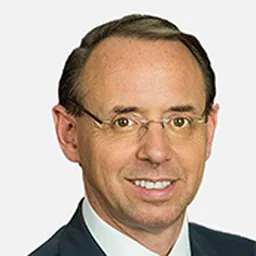
About the Guest
Rod J. Rosenstein is a partner at Baker McKenzie and co-chair of its national security practice. He previously served as Deputy Attorney General of the United States, U.S. Attorney for Maryland, and Principal Deputy Assistant Attorney General for the Tax Division.
In This Episode
Today’s episode is about judgment, justice, and humility.
Rod distinguishes a prosecutable case from a case that merits prosecution. He walks through the questions a prosecutor should ask before charging: “Can I?” “Must I?” and “Should I?”
We talked about Justice Robert Jackson’s April 1940 speech as Attorney General, The Federal Prosecutor, and the power prosecutors hold over liberty and reputation.
Rosenstein says Jackson’s call for discretion, judgment, and humility is critical for all lawyers, not only prosecutors.
Watch the Episode
Timestamps
- 0:00 Welcome to Cited Authorities
- 1:01 A 1990 entry-level job at DOJ
- 2:53 Public Integrity indictment reviews
- 4:51 Prosecutable versus a case that merits prosecution
- 6:39 Can I? Must I? Should I?
- 8:19 Criminal tax versus civil enforcement
- 10:23 Justice Jackson, The Federal Prosecutor
- 14:29 Critical for all lawyers
Resources & Links
- Robert H. Jackson, The Federal Prosecutor (April 1, 1940)
- Justice Manual, Principles of Federal Prosecution
- DOJ Tax Division archive notice
People Mentioned
- Robert H. Jackson, Attorney General (1940–1941) and Associate Justice; Rod discusses the April 1, 1940 speech now known as The Federal Prosecutor
Firms & Organizations
- Baker McKenzie (current role; no hyperlink)
- U.S. Department of Justice; Public Integrity Section (Rod said the section is no longer in existence)
- DOJ Tax Division; IRS civil and criminal tax enforcement
- U.S. Attorney’s Office, District of Maryland (plain text)
Transcript of this episode
Read the transcript
ALEXANDER POWELL: Welcome to Cited Authorities. I’m your host, Alexander Powell. Today I’m honored to have with me Rod Rosenstein. Rod is a partner at Baker McKenzie and co-chair of its national security practice. He previously served as Deputy Attorney General of the United States, U.S. Attorney for Maryland, and Principal Deputy Assistant Attorney General for the Tax Division. Rod, welcome to Cited Authorities.
ROD ROSENSTEIN: Thank you, Alex. I’m very pleased to be here with you.
ALEXANDER POWELL: Rod, before the senior titles, you tried many cases, many jury trials for the government. Can you take us to one case or one situation as a prosecutor in those early days that changed or especially shaped how you understood the role of a prosecutor and prosecutorial discretion?
ROD ROSENSTEIN: You know, Alex, I started in an entry-level job in the Justice Department back in 1990. It was a year after I graduated law school. I completed a clerkship, and at age twenty-four, twenty-five really, I was sworn in as a federal prosecutor, with law school education, but not a lot of background in making those discretionary judgments about when to bring charges. And that was one of the more important things I learned early in my career. Nothing you do in law school really prepares you for that. I know you have the same experience in your roles as an Assistant State’s Attorney in Maryland. You’re thrust into a position at a relatively junior young age, that’s true in most prosecutors’ offices, that a lot of these decisions are made, at least initially, by junior lawyers, where you need to make a decision about whether or not to bring charges. That’s particularly acute in the federal system because state prosecutors’ offices are the office of first resort. Federal prosecutors’ offices are the offices of last resort. They can be selective about what cases they bring. So merely making the threshold determination that somebody’s conduct amounts to a federal crime is just the start of the analysis. It’s not the end. And in fact, under the Principles of Federal Prosecution, we have rules that have been in place in the Justice Department since the late 1970s that set out really a protocol that you go through for evaluating, once you determine that the case is sufficient as a matter of evidence, that is, you believe you would have a reasonable prospect of a jury convicting the defendant with a conviction that would be sustainable on appeal. You then need to make the evaluation about whether or not you personally believe the case merits prosecution by evaluating a variety of factors concerning how it fits with federal prosecution priorities, comparing the case to other cases on which federal prosecutors could spend their time. What impact it’s likely to have in terms of deterrence, what the potential sentence might be. You consider the personal circumstances of the defendant, the putative defendant, the relative culpability. And so there are a whole array of issues that you consider. And I learned that early in my career, because my first job at the Justice Department was with the Public Integrity Section of the Department, which is no longer in existence, but one of the key roles of that section was to evaluate cases that had potential political significance and make sure that prosecutors were fully vetting them before bringing charges. And so we needed to be very careful that if we brought a case against, particularly against a prominent politician, that we had a reasonably high degree of confidence in our ability to get the conviction and that we considered all the potential implications if we were to bring the case. It was an effort to make sure we would bring only the strongest cases against people in politically sensitive positions. So that’s a lesson that I learned early in my career. We had these meetings, we referred to them as indictment review meetings, where we gather senior prosecutors around the table to discuss the facts and the likely defense theories and possible appellate issues that might arise in the case. And we were actually required to write detailed memos, what we called prosecution memos, setting forth the pros and cons about a potential prosecution. That really taught me early on in my career a disciplined way to go about making these decisions and to ensure that we were taking into consideration all those discretionary factors that we rely on prosecutors to consider.
ALEXANDER POWELL: For the lay person, what might they misunderstand about the day-to-day job of a prosecutor, especially within a role so consequential as prosecuting politicians, the Public Integrity unit?
ROD ROSENSTEIN: I think that a very common misconception, and it’s true not just of lay people, but even of some lawyers, is the failure to recognize or to appreciate the difference between believing you have a prosecutable case and believing the case merits prosecution. That is, the fact, as I said, that you believe the evidence is sufficient to obtain and sustain a conviction is not the end of the analysis. It’s only the start. You need to have in the federal system good policy reasons for why you’re going to bring that particular case. And you need to make sure that you’re considering the right factors and not prohibited factors. For example, the person’s political affiliation is not an appropriate consideration. Race, religion, all the prohibited factors that would be unconstitutional might amount to selective prosecution. You have to set those aside and just focus on things that are objective standards that we want our prosecutors to consider in making a determination about whether or not to go forward. But I think that is largely misunderstood. You’ll see often in the media and often politicians will say, we think there’s sufficient evidence, we think that person did it. They should charge him and take him to trial. And as I say, that’s the wrong approach. It’s an approach that’s often used in civil cases. You see civil lawyers, and I do some civil litigation myself, civil lawyers bring cases where they think they have some prospect of success or where their client feels very strongly about whether it be a moral or legal reason that they want to go forward with the case. But as a prosecutor you have an extra obligation to consider the public interest. And I think many people misunderstand that and think that you should pull the trigger and bring the case whenever you can.
ALEXANDER POWELL: I’ve seen in your speaking and preparing for this episode, you have framed that discretion as moving from can I to must I to should I? And I believe that’s what you’re getting at as well, the role of a prosecutor in discretion. That last question, should I, does a lot of work.
ROD ROSENSTEIN: Yeah, and it’s really critical. There are certain types of cases where the must becomes relevant. A case involving, for example, a rape or a murder, you have a victim where you’re confident that you have the right person, you’re not going to exercise discretion in those cases. You’re going to bring those cases. But when there are gray-area cases, or if you’re a federal prosecutor in particular, where the case could be brought by state or local prosecutors, one of the relevant considerations in the Justice Department’s internal manual actually is, do we have an alternative to prosecution? And some of the areas where I spend a lot of my time in white-collar enforcement and tax, for example, there is often an alternative civil remedy. In the IRS, for example, you can always pursue a civil case with interest and penalties. And under DOJ protocols, you’re supposed to consider that. Now, it’s not an automatic decision that if there is a civil alternative, you should use it. But it’s a relevant consideration because in many run-of-the-mill cases where there aren’t extenuating circumstances, those civil or administrative remedies might be an effective way to provide a punishment and a deterrent without the significant expense and risk of a trial or the need to send somebody to prison.
ALEXANDER POWELL: Dovetailing with that answer, Rod, do you believe that criminal tax prosecution versus civil tax enforcement, that civil tax enforcement is especially equipped to accomplish those tasks that you just mentioned, as opposed to pursuing criminal tax enforcement, which of course has a primary purpose of deterrence?
ROD ROSENSTEIN: In some cases. Tax cases are particularly challenging for prosecutors because taxes are very complicated and many people, perhaps even most people, make mistakes on their tax returns that are innocent mistakes in the sense that they really don’t know or don’t understand the significance of the tax laws. And so in order to be guilty of a criminal tax law, the government has to prove not just that you violated the law, but that you did so willfully, that you actually knew that you had a legal obligation that you violated. In most criminal cases we say ignorance of the law is no excuse. In tax law, it actually is an excuse. And more than just an excuse, it’s the government’s burden to overcome the presumption that the defendant didn’t act willfully, that is, didn’t know what the tax laws were that he or she was violating. And so that’s an area where I think civil enforcement is particularly appropriate in many cases. In addition to that, with tax enforcement you’re often dealing with first offenders and a person’s criminal history is relevant. Many of the people we prosecute in the federal system are repeat offenders who don’t wind up with federal charges the first time they’ve committed a crime. And so the risk of recidivism is something we consider, the degree of dangerousness, the ability to obtain restitution through a civil or administrative remedy. And so there are some tax cases that deserve to be prosecuted where we need to send people to prison in order to establish an effective deterrent and send a message. But in many cases, for most violations, a civil penalty is probably a reasonable and appropriate resolution for a first offender.
ALEXANDER POWELL: Rod, switching gears, when we first met and corresponded, I told you that I kept Justice Jackson’s, Justice Robert Jackson, his writing The Federal Prosecutor, pinned in my office in Annapolis when I was an Assistant State’s Attorney. You said that you rarely gave a speech as Deputy Attorney General without quoting The Federal Prosecutor by Justice Jackson. Jackson described the prosecutor who tempers zeal with kindness and approaches the job with humility. You’ve supervised many prosecutors during your career. How can you tell when zeal might have the tendency to overtake judgment for a young prosecutor?
ROD ROSENSTEIN: That’s critically important for a prosecutor, particularly in the gray-area crimes, white-collar crimes where it really all turns on intent and you can’t always with any degree of certainty know what somebody’s intent was. It’s a question of their state of mind. That started out really unintentionally. I quoted Jackson a lot and it reached the point where about halfway through my tenure as Deputy AG, my staff would joke about the fact that they had an obligation to put a Robert Jackson quote in every draft speech they prepared for me. I don’t know that I was familiar with Jackson when I first started prosecuting, but pretty early in my career I came across that. It’s a speech actually, and you quoted an excerpt from it. Jackson is best known for his tenure as a Supreme Court justice and for his unusual service as a prosecutor in Nuremberg. He actually left the Supreme Court temporarily, took leave to go over and prosecute the Nazis in Nuremberg, but he was very briefly, really in 1940 and 1941, Attorney General of the United States. His career is really remarkable. Jackson was the last Attorney General who didn’t have a formal legal degree. He rose through the Roosevelt administration through a series of jobs, including head of the Tax Division, where he was in these jobs very briefly and excelled and was promoted up the chain. During his relatively brief tenure as Attorney General, he gave this speech from which you quoted. It was April 1 of 1940. And it’s become very well known by federal prosecutors and judges. The title that’s been given to the speech is The Role of the Federal Prosecutor. And Jackson spoke about the tensions for prosecutors who are pressured to bring cases and have an ethical obligation to consider all those discretionary factors that you pointed to and avoid being influenced by political considerations or by passing popular will to prosecute. The issue at that particular time, the concern was that anti-war protesters and potential Nazi sympathizers or communist sympathizers in the United States were being targeted for prosecution, and Jackson wanted to make sure that the government was being sensitive, to make sure that they weren’t being unfairly prosecuted. He also was dealing with another issue that arose in my time, and that is the tension between the headquarters components of the Justice Department, the Attorney General and the team in Washington, versus the U.S. Attorneys in the field, and who should be making those decisions about whether or not there ought to be uniformity around the country in areas like tax enforcement. And it’s all captured in that speech, which is just a few pages. It’s really worth a read, and includes quotations like the one that you read about the critical importance of prosecutors exercising discretion and judgment and humility. And I think that’s critical, Alex, not just for prosecutors, but really for all lawyers.
Next on Cited Authorities
Andrew T. Wise